12/05/2026
Cyber Security Jobs in the UK: Career Paths, Certifications & the Talent Shortage Opportunity
Introduction
Cyber security jobs represent one of the most urgent talent priorities in the UK technology market. The UK Cyber Security Council and DCMS have repeatedly highlighted a significant skills gap: demand for cyber security professionals consistently outstrips supply, creating exceptional career opportunities for those with the right skills and mindset. From Security Operations Centre (SOC) analysts monitoring threats in real time to penetration testers probing for vulnerabilities, and CISO-level executives shaping enterprise security strategy, the cyber security career ladder is both deep and well-remunerated.
Authority in cyber security flows from demonstrated competence and trust. The security professional who has caught a live intrusion, closed a critical vulnerability before it was exploited, or successfully led a security transformation programme carries the kind of organisational influence that takes years to earn in other disciplines — but can be built surprisingly quickly given the speed at which threats evolve.
Key Roles Within Cyber Security
Security Operations Centre (SOC) Analyst roles form the entry point for many cyber security careers. SOC analysts monitor security event logs, investigate alerts, perform initial triage, and escalate confirmed incidents. They work with SIEM platforms (Splunk, Microsoft Sentinel, IBM QRadar) and endpoint detection and response (EDR) tools. Penetration Testers (ethical hackers) simulate cyberattacks against clients' systems to identify vulnerabilities. They use tools such as Kali Linux, Burp Suite, Metasploit, and Nmap, and produce detailed reports documenting findings and remediation recommendations.
Security Engineers design and implement security controls: firewalls, intrusion detection systems, identity and access management platforms, and encryption frameworks. Threat Intelligence Analysts research the tactics, techniques, and procedures (TTPs) of threat actors and produce intelligence products that inform defensive strategy. Cloud Security Engineers specialise in securing cloud environments — a rapidly growing specialism as organisations migrate workloads to Azure, AWS, and GCP.
Certifications That Open Doors
CompTIA Security+ is the most widely recognised entry-level certification and appears as a minimum requirement in many SOC analyst and junior security engineer job descriptions. CompTIA CySA+ and PenTest+ provide mid-level validation. The OSCP (Offensive Security Certified Professional) is the gold standard for penetration testers and is highly valued by employers in the offensive security space. CEH (Certified Ethical Hacker) is also recognised, though OSCP carries more weight in technical hiring.
For cloud security, the AWS Certified Security Specialty and Microsoft SC-100 (Cybersecurity Architect Expert) are the leading credentials. CISSP (Certified Information Systems Security Professional) remains the pre-eminent qualification for senior security managers and architects. CISM (Certified Information Security Manager) is valued for those transitioning into security management roles.
Salary and Market Conditions
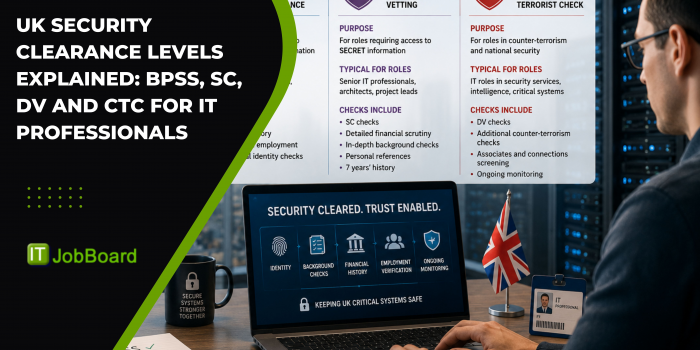
Junior SOC analysts typically earn £28,000 to £40,000. Mid-level security analysts and engineers earn £45,000 to £65,000. Senior security engineers and penetration testers command £65,000 to £85,000. Security architects and managers earn £80,000 to £110,000. CISOs at large organisations earn £120,000 to £200,000 or more. Contract penetration testers earn £500 to £850 per day. SC-cleared or DV-cleared security professionals working in government and defence are in exceptional demand and command premium rates.
Breaking Into Cyber Security
Many successful cyber security professionals enter through adjacent disciplines. Helpdesk jobs and IT engineering jobshttps://www.itjobboard.co.uk/categories/355/engineering-jobs/Cisco jobshttps://www.itjobboard.co.uk/categories/1229/cisco-jobs/ provide network knowledge that maps directly onto network security. Home lab practice — running TryHackMe, HackTheBox, or building a personal SIEM environment — is widely respected as evidence of genuine interest and self-directed learning. The combination of a relevant certification and documented practical experience is the most reliable path to landing a first cyber security role.
The cyber security skills shortage means that motivated candidates with the right attitude and foundational skills are considered seriously even without extensive experience. Employers increasingly hire on potential and invest in training, particularly for SOC analyst roles.